BlogFabrication & Hardware13 Sep 20268 min read
When to Build a Machine Instead of Importing One
The test is not price. It is whether the machine can be serviced here when it fails. A worked example from the workshop floor.
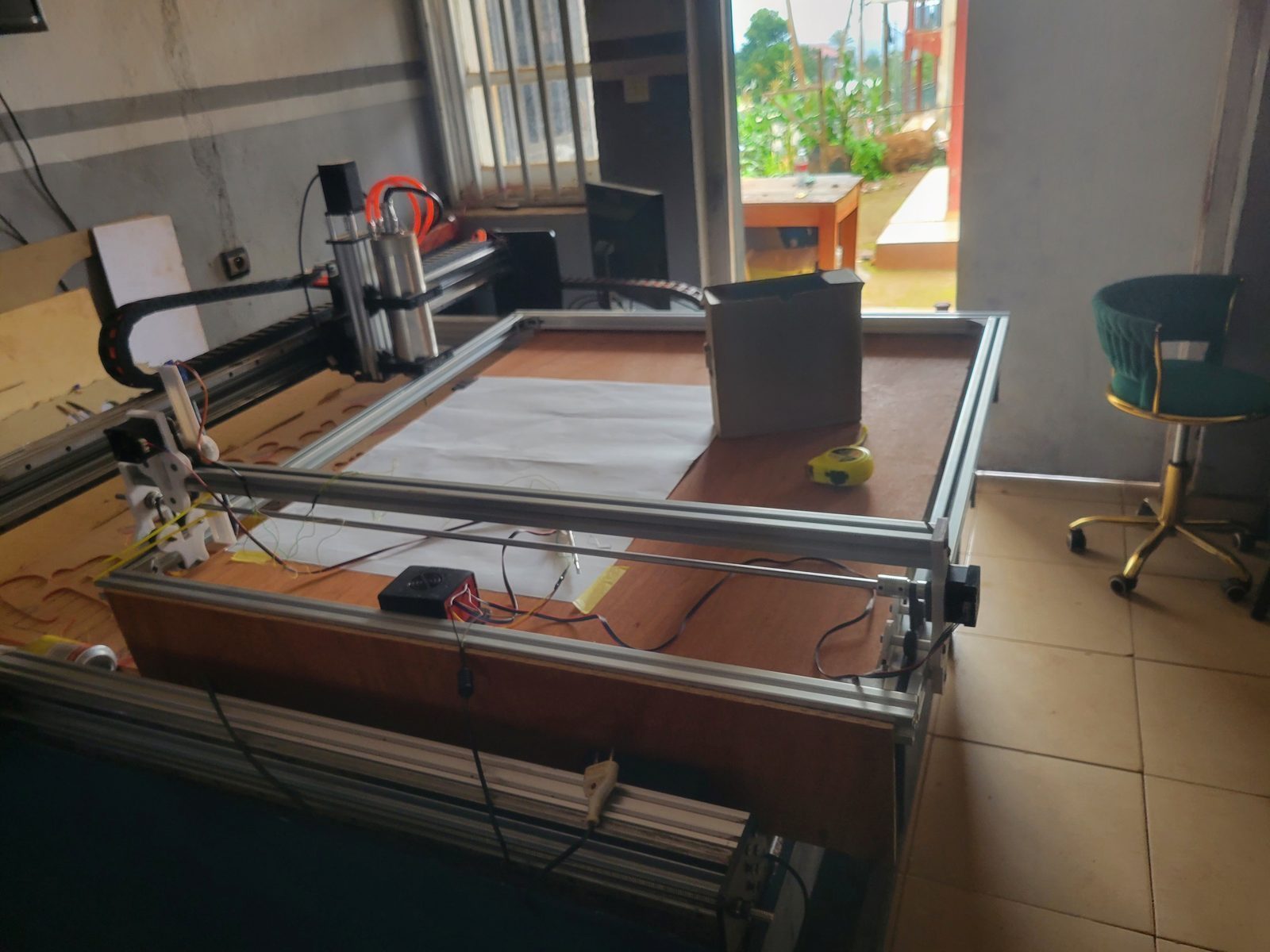
A custom machine build in Cameroon makes sense when the imported machine cannot be serviced here. That is the test. Not price, not pride, not local content. If the machine breaks in eighteen months and the nearest person who can open it is in Europe, then you have not bought a machine, you have rented one until it fails. We build machines at NestX in Bamenda, and this is the honest reasoning we use before we agree to build one.
The worked example: an automatic microscope slide stainer
A laboratory technician staining slides by hand does the same sequence all day. Dip the rack in one reagent, wait a set time, lift, drain, move to the next, wait, repeat, rinse, dry. It is precise, it is repetitive and it is exactly the kind of work a machine should do. Doing it by hand means timings drift when the lab is busy, results vary between technicians, and the technician spends the morning standing over a bench instead of reading slides.
Commercial automatic stainers exist. They are imported, they are expensive, and when one fails in the North West the service engineer is not in the country. Consumables and spares are proprietary. That is the situation the lab was in.
What we actually did
- Understood the process first. We watched the manual procedure and wrote down every step, every dwell time and every point where a technician makes a judgement call. Automating a process you have not watched is how you build a machine that does the wrong thing accurately.
- Designed it in CAD. The full machine: frame, rack carrier, vertical lift, horizontal travel, reagent stations, drip management and control mounting. Designing in CAD before cutting metal means the mistakes are free.
- Printed the parts that suited printing. Rack holders, carriers, guides, brackets, sensor mounts, covers and housings. Printed parts let us test a shape on Tuesday, find it wrong, change it and test the revised version on Wednesday.
- Built a working prototype. Not a render, not a mock-up. A machine that moves a rack through a sequence with controlled timing.
- Iterated on the real failures. Every prototype teaches you something the drawing did not. Drip carry-over between stations, rack seating, lift smoothness. Each one became a revision.
The point of that list is that none of it depended on anyone outside Bamenda. Every part we made, we can remake.
The real argument: serviceability
Here is what happens when an imported machine fails in this region. You contact the supplier. The supplier asks for the model and serial. They identify a part. The part is proprietary, so there is no alternative source. Freight, then customs, then whatever the day brings. Weeks pass. If the model has been discontinued the answer is that you should buy the new model.
Here is what happens when a machine we built fails. You message us. We have the CAD file, the bill of materials and the wiring. If it is a printed part we print it. If it is a machined part we machine it. If it is a standard component such as a bearing, a stepper motor, a belt or a power supply, it is standard on purpose, because we chose standard parts precisely so they could be replaced.
| Imported machine | Machine built here | |
|---|---|---|
| Spare parts | Proprietary, single source | Standard components plus parts we can remake |
| Who can service it | An engineer abroad | The workshop that built it |
| Downtime after a failure | Weeks, subject to freight and customs | Days |
| Documentation | Usually a user manual only | CAD files, bill of materials, wiring |
| Fit to your actual process | Whatever the manufacturer assumed | Built around what your technicians do |
| Power assumptions | Designed for stable mains | Designed knowing the power will cut |
| Discontinued model risk | Machine becomes scrap | Files still exist |
Power is a design input, not an excuse
Around 72% of Cameroon had electricity access in 2023 according to World Bank data, and access is not the same as stability. ENEO has implemented rotational rationing across the Southern Interconnected Grid, which includes the North West. A machine designed in a country with steady mains treats a power cut as an emergency. A machine designed here has to treat it as normal.
In practice that means asking what happens mid-cycle when the power goes. Does the machine know where it was. Does it park safely. Can a technician resume without ruining the batch. Those questions get answered at the design stage or they get answered painfully, in the field, by your staff.
When you should import instead
We turn work down, and here is when.
- The machine is a commodity and well supported locally. If you can buy it in Douala and get it serviced in Douala, buy it.
- It needs certification we cannot provide. Diagnostic and clinical equipment that must carry a regulatory mark is not ours to build.
- It depends on precision we cannot reach. Sub-micron positioning, high pressure vessels, hard metal wear surfaces at speed.
- You need twenty of them next month. We build in small numbers. Volume manufacturing is a different business.
- Nobody on your side will own it. A custom machine needs a person in your organisation who understands it. Without that, it becomes an expensive shelf.
How a build actually runs
- Process study. We come and watch, or you record it and talk us through it. We write the sequence down and you correct us.
- Specification. What the machine must do, what it must not do, what it runs on, who operates it, what happens when power fails.
- CAD design and review. You see the machine before it exists and tell us what is wrong.
- Prototype. Printed and cut parts, standard components, real motion.
- Testing against your process. With your materials, your reagents and your technicians, not ours.
- Revision. There is always a revision. Anyone who says otherwise has not built a machine.
- Handover. Machine, documentation, spares list, and training for the people who will run it.
We do the same on smaller builds. Egg incubators up to 700 eggs come out of this process, and so do the large-format 3D printers we run in our own workshop.
Cost
We do not quote a custom machine from a phone call, and you should not trust anyone who does. What drives the cost is the design hours, the components, the machine time to make the parts and the number of prototype revisions the problem needs. Describe the process and you get a quote in 24 hours, with the scope written down so both sides know what is in it.
Past builds are in the portfolio and in the gallery. If the failure you are dealing with is one component rather than a whole machine, start with spare parts nobody imports. The printing capability underneath all of this is described in what you can actually get 3D printed in Cameroon.
Describe the process
Message the workshop on WhatsApp and tell us what the job is, who does it now and how long it takes. We will tell you honestly whether to build or to buy, and quote in 24 hours. The full capability list is on the services page.
Questions people ask
When does it make sense to build a machine instead of importing one?
When the imported machine cannot be serviced here. If spares are proprietary and the nearest engineer is abroad, a failure means weeks of downtime. A machine built locally uses standard components and parts the builder can remake.
What machine have you actually built?
An automatic microscope slide stainer, taken from process study through CAD to a working prototype, with a large share of the mechanism 3D printed. We also build egg incubators up to 700 eggs and the large-format 3D printers we run in the workshop.
Is a custom machine cheaper than an imported one?
Not always, and that is not the argument. The argument is serviceability, spares and fit to your actual process. Cost depends on design hours, components, machine time and how many prototype revisions the problem needs.
When would you tell me to import instead?
When the machine is a commodity well supported locally, when it needs certification we cannot provide, when it demands precision beyond our processes, when you need many units quickly, or when nobody on your side will own and operate it.
How do you design around power cuts?
We treat a cut as normal rather than as an emergency. The design has to answer what happens mid-cycle: whether the machine knows its position, whether it parks safely, and whether a technician can resume without ruining the batch.
What do I get at handover?
The machine, documentation including CAD files and bill of materials, a spares list, and training for the people who will run it. Standard components are chosen deliberately so they can be replaced locally.