BlogFabrication & Hardware13 Sep 20267 min read
3D Printing in Cameroon: What You Can Actually Get Made
What a 3D printing workshop in Bamenda can make for you, what it cannot, and what to send to get a quote.
Yes, 3D printing is available in Cameroon. You do not have to ship a small plastic part from China and wait six weeks for it. NestX runs a 3D printing service in Bamenda, North West Region. We print parts from a 3D file, from a technical drawing, or from a broken component you hand us across the counter. We deliver to Bamenda, Buea, Douala, Yaounde and anywhere a transport agency runs. Most people who message us have never watched a 3D printer work, so this post covers what the machines really do, where they fail, and exactly what you need to send to get a part made.
What a 3D printer actually does
A 3D printer builds a solid object in thin layers. A motor pushes plastic filament through a hot nozzle, the nozzle draws one flat slice of your part, the bed drops a fraction of a millimetre, and the next slice goes on top. Repeat a few thousand times and you have a finished part. Nothing is carved away and no mould is needed. That is the whole reason it suits Cameroon: one part costs about the same per unit as ten parts, so you can make exactly what you need without tooling.
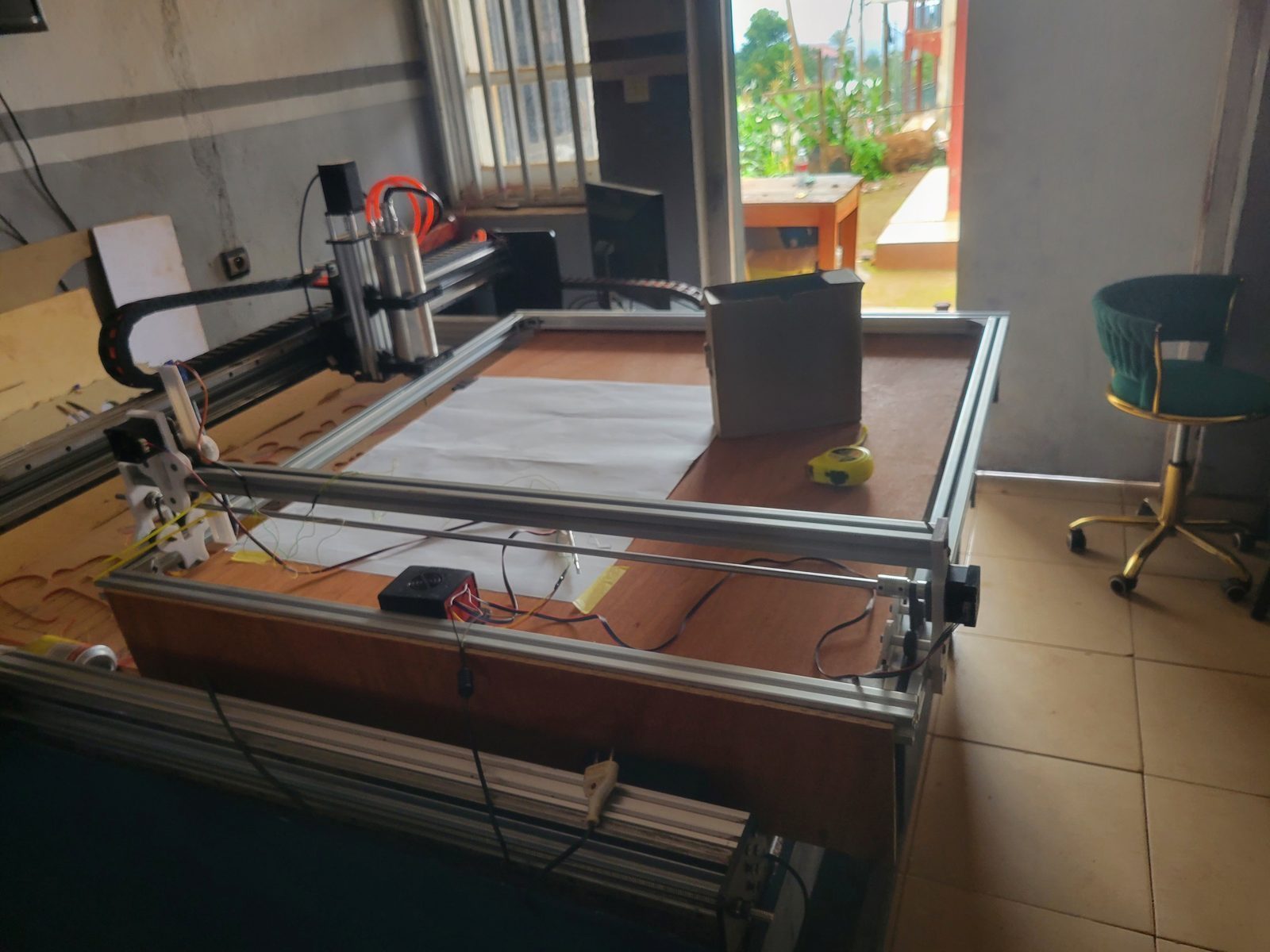
We build our own large-format printers in the workshop. That matters for a practical reason. When a hotend blocks or a belt stretches, we do not open a support ticket with a company in Shenzhen. We machine or print the replacement the same day. A workshop that cannot repair its own machines cannot promise you a turnaround date.
What we print most often
- Spare parts that nobody imports. Gears, knobs, bushes, handles, clips, fan shrouds, feed rollers. The part that killed your machine is often a 2000 FCFA piece of plastic that no shop in the country stocks.
- Prototypes. A physical version of your product before you commit money to a mould or a production run. Hold it, show it to a customer, find the mistake, print version two.
- Housings and enclosures. Boxes for electronics, sensor mounts, panel bezels, cable guides.
- Laboratory and clinic fittings. Racks, holders, adapters, custom clamps. We built an automatic microscope slide stainer from CAD to a working prototype, and a large share of that machine is printed.
- Agricultural hardware. Parts for our egg incubators, which we build in sizes up to 700 eggs, plus turner components, vent covers and sensor housings.
- Jigs and fixtures. The unglamorous parts that let a small workshop repeat the same operation accurately all day.
What 3D printing cannot do
An honest workshop tells you when to use a different process. Printed plastic is not steel. It will not hold a heavy structural load, it will not survive next to an exhaust manifold, and it is not the right answer for optically clear windows. It is also the wrong process for a thousand identical small parts, where injection moulding wins on cost once you can justify the mould. For flat sheet work in acrylic, plywood or PVC, our CNC router and laser cutter are faster and cheaper than printing.
| What you need | Right process | Why |
|---|---|---|
| One replacement gear or knob | 3D printing | No mould, no minimum order |
| Product prototype before production | 3D printing | Cheap to change and reprint |
| Shop signboard in acrylic | Laser cutting | Flat sheet, clean polished edge |
| Plywood panels and furniture parts | CNC routing | Large sheets, fast removal |
| Part that sits against an engine block | Metal machining | Plastic softens with heat |
| 2000 identical bottle caps | Injection moulding | Printing cannot match unit cost at volume |
What to send us
You can start from any of four positions, and none of them requires you to know CAD.
- A 3D file. STL or STEP is ideal. OBJ and 3MF are fine. If you downloaded it or an engineer sent it, send it as it is.
- A 2D drawing. A PDF or even a clear hand sketch with dimensions in millimetres works. Mark which faces must fit something else.
- The broken part. This is the most common route. Bring it to the workshop or send it by transport agency. We measure it with callipers and rebuild it in CAD.
- Photographs plus measurements. If the machine cannot be stripped, photograph the part from several angles with a ruler or a coin in the frame, then send the critical dimensions separately.
The single most useful thing you can tell us is what the part does. A gear that spins under load and a cosmetic cover look similar in a photo but need different materials, different wall thicknesses and different print orientation.
Materials, and why Cameroon changes the answer
We print mainly in PLA and PETG, and we make both from post-consumer plastic collected here. PLA is stiff, accurate and easy to print, but it softens in real heat. A PLA part left on a dashboard in Douala at midday, or bolted under a tin roof in Bamenda in March, can deform. PETG holds up far better in heat and takes impact without cracking. If your part will sit in the sun, in a vehicle, or near a motor, we will steer you to PETG. We go through the trade-offs properly in PLA or PETG for Cameroon's heat and humidity.
Humidity is the other local factor. Filament absorbs water out of the air, and wet filament prints badly: rough surfaces, weak layers, popping noises at the nozzle. We dry filament before every serious job. It is not optional here.
Turnaround, power and cost
Print time is measured in hours, not minutes. A small bracket may take two hours. A large housing can run for twenty. That is the real constraint on turnaround, and ENEO rationing makes it sharper. ENEO has implemented rotational load rationing across the Southern Interconnected Grid, which includes the North West, so long prints get scheduled around known outage windows and critical jobs run on backup. We would rather quote you an honest three days than promise tomorrow and miss it.
On price, we do not publish a per-gram rate, because it would be misleading. What drives your cost is straightforward: how much plastic the part uses, how many hours the machine is tied up, whether we have to model it in CAD first, and how much finishing it needs. Send the part or the file and you get a quote in 24 hours. If the design needs work before it can be printed, we tell you that in the same message rather than discovering it halfway through.
Ordering from outside Bamenda
Most of our work arrives on WhatsApp. Send photos and dimensions, we quote, you confirm. Payment goes through MTN MoMo or Orange Money. Finished parts travel by transport agency to Douala, Yaounde, Buea, Bafoussam and elsewhere, usually overnight, and we send you the waybill number. For a small part the transport cost is minor next to the price of importing a replacement.
Before you order
Two habits save everyone time. First, measure in millimetres and write the numbers down rather than describing the size with your hands. Second, tell us the fit that matters. If a shaft must pass through a hole, say so, and give us the shaft diameter. Printed parts can be made to fit precisely, but only when we know which dimension is the critical one.
You can see finished work in the gallery, and the full list of what the workshop does is on the services page. If you are replacing a failed component on a machine, read spare parts nobody imports next.
Send us the part
Message the workshop on WhatsApp with a photo, a file or a description, and we will come back with a quote in 24 hours. You can also reach us through the contact page or browse everything we make on the services page.
Questions people ask
Is there really a 3D printing service in Cameroon?
Yes. NestX prints in Bamenda, North West Region, and ships finished parts by transport agency to Douala, Yaounde, Buea and elsewhere. You send a file, a drawing or the broken part itself.
How much does a 3D printed part cost?
We do not publish a fixed rate because cost depends on the material used, the hours of machine time, whether we have to model the part in CAD first, and the finishing required. Send the part or the file and you get a quote in 24 hours.
What file format should I send?
STL or STEP is best. OBJ and 3MF also work. If you have no 3D file, send a dimensioned PDF, a clear sketch in millimetres, or photographs of the part with a ruler in the frame.
Can you copy a broken part I already have?
In most cases yes. We measure the part with callipers and rebuild it in CAD. Send both halves if it snapped, and tell us what the part does so we choose the right material.
How long does a print take?
Hours, not minutes. Small brackets run in about two hours, large housings can take twenty or more. We also schedule long prints around ENEO rationing windows, so we quote a realistic date rather than an optimistic one.
Can you print in metal?
No. We print in plastic, mainly PLA and PETG. For metal parts we will tell you honestly that machining or fabrication is the right route.